
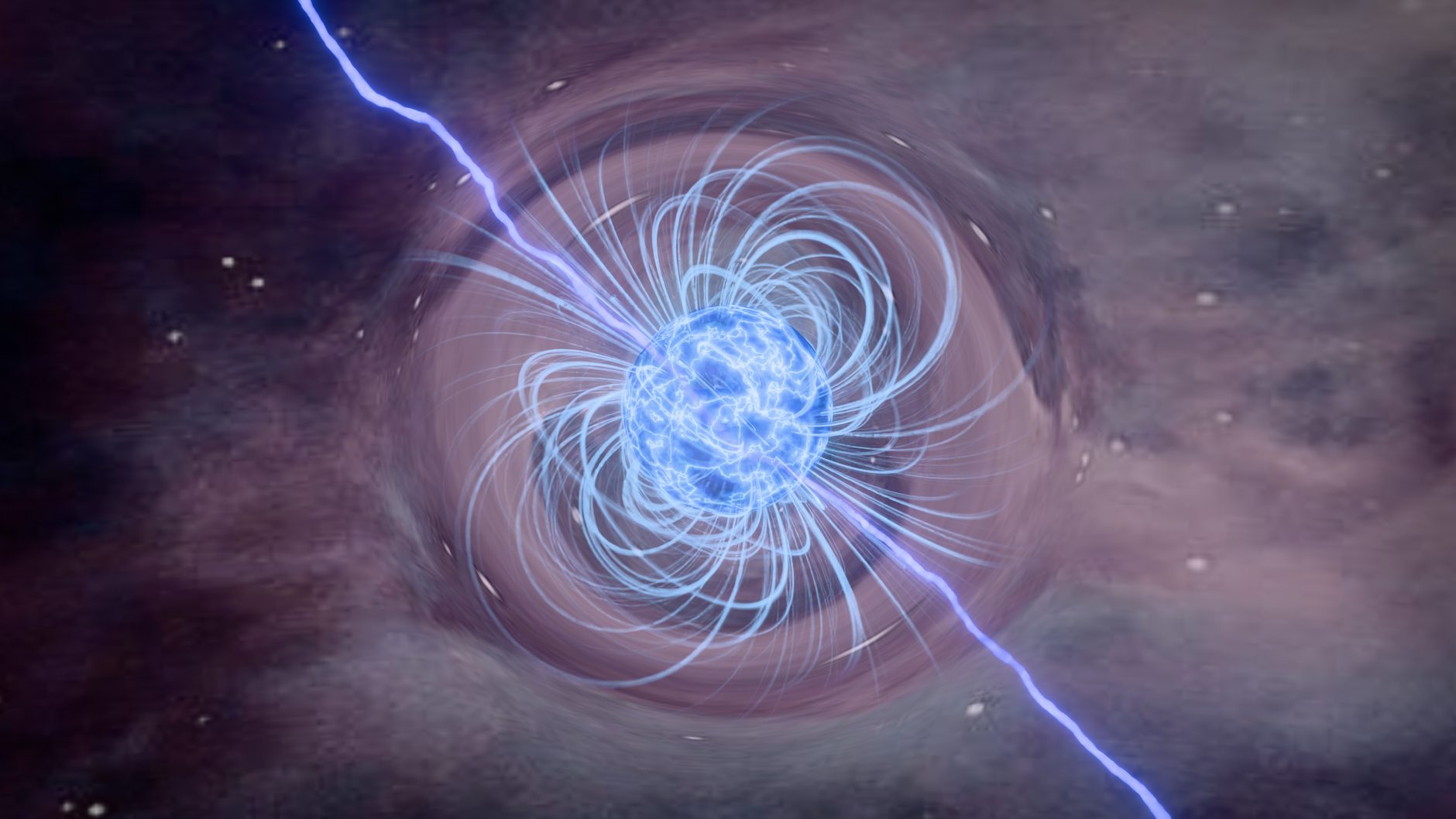
The supermassive neutron star is shedding light on the mass gap between neutron stars and black holes. This fascinating discovery could reshape our understanding of stellar evolution.
What is a supermassive neutron star?
A supermassive neutron star is a highly dense astronomical object, formed from the remnants of massive stars that have undergone supernova explosions. Unlike regular neutron stars, which typically have masses between 1.4 and 2.16 solar masses, supermassive neutron stars can possess masses exceeding 2.5 solar masses. This unique class of neutron stars challenges existing theories about stellar evolution and the fundamental limits of gravity.
The formation of a supermassive neutron star occurs in extreme conditions, where the gravitational forces are so strong that they counteract the pressure from nuclear reactions. As a result, they can exhibit fascinating characteristics, such as rapid rotation and intense magnetic fields. Researchers believe that these stars may serve as crucial links in understanding the enigmatic mass gap between neutron stars and black holes, a region in the mass spectrum where few objects are observed.
By studying supermassive neutron stars, scientists hope to gain insights into the processes that lead to black hole formation and the nature of dense matter under extreme conditions. Their study could also reveal more about the universe’s early evolution and the lifecycle of massive stars.
Understanding the mass gap
Understanding the mass gap is crucial in the study of stellar evolution and the formation of compact objects. The mass gap refers to a range of stellar masses where no stable astronomical objects, such as neutron stars or black holes, are expected to exist. This gap typically lies between the heaviest known neutron stars and the lightest black holes.
Recent observations of a likely supermassive neutron star have provided new insights into this phenomenon. Scientists believe that the existence of such an object may challenge existing theories regarding the formation mechanisms of neutron stars and black holes.
Key points that are being explored include:
- The upper mass limit of neutron stars, which current models suggest is around 2 to 3 solar masses.
- The lower mass limit for black holes, which is generally considered to be around 5 solar masses.
- The processes leading to the formation of either type of object in the aftermath of stellar explosions.
By studying the characteristics of the supermassive neutron star, researchers hope to bridge this mass gap and gain a deeper understanding of the fundamental nature of these extreme celestial bodies.
The significance of neutron stars
The discovery of a supermassive neutron star provides crucial insights into the enigmatic mass gap that separates neutron stars from black holes. This mass gap, a region where very few astrophysical objects are found, has puzzled scientists for decades. Understanding the nature and formation of supermassive neutron stars is essential for unraveling the mysteries surrounding this gap.
Neutron stars, the remnants of supernova explosions, are incredibly dense and possess strong gravitational forces. However, when their mass exceeds a certain limit, they are theorized to collapse into black holes. The existence of supermassive neutron stars challenges this conventional understanding and opens new avenues for research.
Through detailed observations and studies, researchers aim to:
- Investigate the properties of supermassive neutron stars
- Explore their formation mechanisms
- Assess their role in the broader context of stellar evolution
Ultimately, these investigations could bridge the gap in our knowledge of the transition between neutron stars and black holes, shedding light on fundamental questions about the universe.
How black holes differ
The discovery of a supermassive neutron star has sparked discussions about the differences between neutron stars and black holes. While both are remnants of massive stars, their characteristics and formation processes diverge significantly.
Neutron stars are incredibly dense, typically formed from the collapse of a massive star during a supernova. Their mass can reach about 2 to 3 solar masses, but the existence of supermassive neutron stars challenges these traditional limits. In contrast, black holes are formed when a massive star collapses under its own gravity without any opposing forces to stop the contraction, leading to a point of singularity.
Key differences include:
- Density: Neutron stars have a solid surface and are composed mainly of neutrons, while black holes possess an event horizon with no physical surface.
- Mass: The mass of neutron stars is limited by the Tolman-Oppenheimer-Volkoff limit, while black holes can grow indefinitely by accumulating mass.
- Radiation: Neutron stars emit radiation and are observable, whereas black holes do not emit light, making them detectable only through their gravitational effects.
Understanding these differences is crucial in studying the mass gap and the role of supermassive neutron stars in the cosmos.
Recent discoveries in astronomy
Recent discoveries in astronomy have shed light on the elusive nature of supermassive neutron stars, particularly in relation to the mass gap that exists between neutron stars and black holes. Researchers have identified a potential supermassive neutron star, which offers a unique opportunity to explore this phenomenon.
The mass gap is an intriguing aspect of astrophysics, as it highlights a range of masses where no stable objects have been observed. This discovery could help bridge the gap, providing crucial insights into how these celestial bodies form and evolve over time. The findings indicate that the formation of a supermassive neutron star may occur under specific conditions that are yet to be fully understood.
Furthermore, astronomers are utilizing advanced observational techniques to study these supermassive neutron stars more closely. This includes:
- High-resolution imaging from space telescopes
- Gravitational wave detections
- Advanced simulations of stellar evolution
As research progresses, the study of supermassive neutron stars could unlock further mysteries of the universe, enhancing our understanding of fundamental astrophysical processes.
Future research directions
As researchers continue to investigate the enigmatic supermassive neutron star, several future research directions are emerging that could further illuminate our understanding of the mass gap between neutron stars and black holes.
Firstly, advanced observational techniques, such as gravitational wave astronomy, may provide unprecedented data. These observations could help astronomers identify more candidates for supermassive neutron stars, facilitating a deeper analysis of their properties and formation mechanisms.
Additionally, theoretical models will need refinement. Researchers aim to develop simulations that can accurately predict the behavior of matter under extreme conditions, which is crucial for understanding how these astronomical giants evolve.
Another promising avenue involves collaboration across multiple disciplines. By combining insights from astrophysics, nuclear physics, and computational modeling, scientists hope to construct a more comprehensive picture of how supermassive neutron stars fit into the broader cosmic framework.
Finally, public outreach and engagement will also play a significant role. By fostering interest in these celestial objects, researchers can inspire the next generation of scientists to explore the universe’s most profound mysteries.
The discovery of the supermassive neutron star challenges existing theories about stellar evolution and the formation of compact objects. Researchers believe that this supermassive neutron star may bridge the gap in our understanding of the mass gap between black holes and neutron stars.
Photo by Nicola Narracci on Pexels